Quick answer
FUE hair transplant (follicular unit extraction) moves follicles one by one from the back of the scalp to thinning areas, leaving no linear scar. In Lahore it is performed by FCPS plastic surgeon Dr. Junaid Fateh. It takes 4 to 8 hours under local anaesthetic, with 7 to 10 days of recovery. New hair shows at 6 to 12 months and is usually permanent. Cost is confirmed after consultation.
Also known as: Follicular unit extraction, Follicular unit excision, FUE hair transplantation, Sapphire FUE, DHI hair transplant, Baal lagwana, Ganjapan ka ilaj · ایف یو ای ہیئر ٹرانسپلانٹ
About FUE hair transplant
FUE stands for follicular unit extraction. Instead of removing a strip of skin, hair is taken one follicular unit at a time, usually from the back and sides of the head, and each graft is placed into the thinning area. A follicular unit is the natural cluster of one to four hairs that grows together from the scalp, so the transplanted hair grows in the same small groups as the rest of your hair.
The back and sides of the scalp are usually resistant to the hormone-driven thinning behind male pattern baldness. Hair moved from there tends to keep that resistance in its new position, which is why a well-planned FUE transplant is a long-term treatment. The hair you have not had transplanted can still thin with time, so planning for the future is part of every consultation.
Because there is no strip, FUE does not leave a linear scar. It does leave many tiny round marks in the donor area. Once your hair grows back these are usually very hard to see, even with a fairly short haircut.
How Dr. Junaid approaches FUE hair transplant
Dr. Junaid Fateh plans a hair transplant with the same care as any other operation. At your consultation he examines your scalp, the pattern and stage of your hair loss, and the density and quality of your donor hair. He also asks about your health, medicines and family history. If the reason for your hair fall is unclear, he may suggest blood tests before deciding on surgery.
He then talks honestly about what is realistic. Donor hair is limited, so the aim is to use it where it makes the most visible difference while keeping some in reserve in case you need more work later. Your hairline is drawn on before surgery and adjusted with you in the mirror until it looks right. He designs it to suit your age and face, with a soft, slightly irregular edge and fine single hairs at the front, because a hairline that is too low or too straight is what usually gives a transplant away.
Safety runs through every step. The procedure is carried out under sterile conditions, the graft count stays within what your donor area can safely give, and Dr. Junaid goes through the possible risks with you at consultation, including swelling, temporary numbness, infection, shedding of existing hair and uneven growth.
Techniques and options
Options Dr. Junaid may recommend include:
- Hairline restoration: rebuilding a receding front and temples with carefully angled single- and two-hair grafts.
- Crown treatment: filling the thinning patch on the back of the top of the head, where hair grows in a swirl that has to be copied closely.
- Channel and placement method: the way recipient sites are opened and grafts are placed is chosen to suit your hair type and the area being treated.
- Staged sessions: for larger areas, the work may be split into two sessions several months apart to protect graft quality and the donor area.
- Beard hair as extra donor: in selected cases with limited scalp donor hair, hair from under the chin may add to the grafts available.
- Combined treatment: medication or PRP hair therapy may be advised to help protect the hair you already have.
- Sapphire FUE: Recipient channels are opened with fine sapphire blades, which allows small, precise openings and closely packed grafts.
- DHI (direct hair implantation): Grafts are loaded into a pen-like implanter and placed directly, which gives fine control over angle and depth, especially along the hairline.
- Body hair transplant: For people with very limited scalp donor hair, hair from the beard area or chest may be used to add density in selected cases.
- Large single sessions: When the donor area allows, a higher number of grafts can be moved in one longer session, so long as graft quality is not compromised.
- Robotic FUE: A robotic system assists with mapping and extracting follicles in a consistent pattern. Dr. Junaid still designs the hairline and plans graft placement himself, and will advise whether robotic or manual extraction suits your hair type.
What to expect on the day
You arrive in the morning, the hairline is confirmed and the donor area is trimmed short. Local anaesthetic numbs the scalp, after which most people feel only pressure. Extraction and placement fill most of the day, with pauses for meals and namaz along the way. You leave the same day with written aftercare instructions and a WhatsApp contact for the team.
Before & after
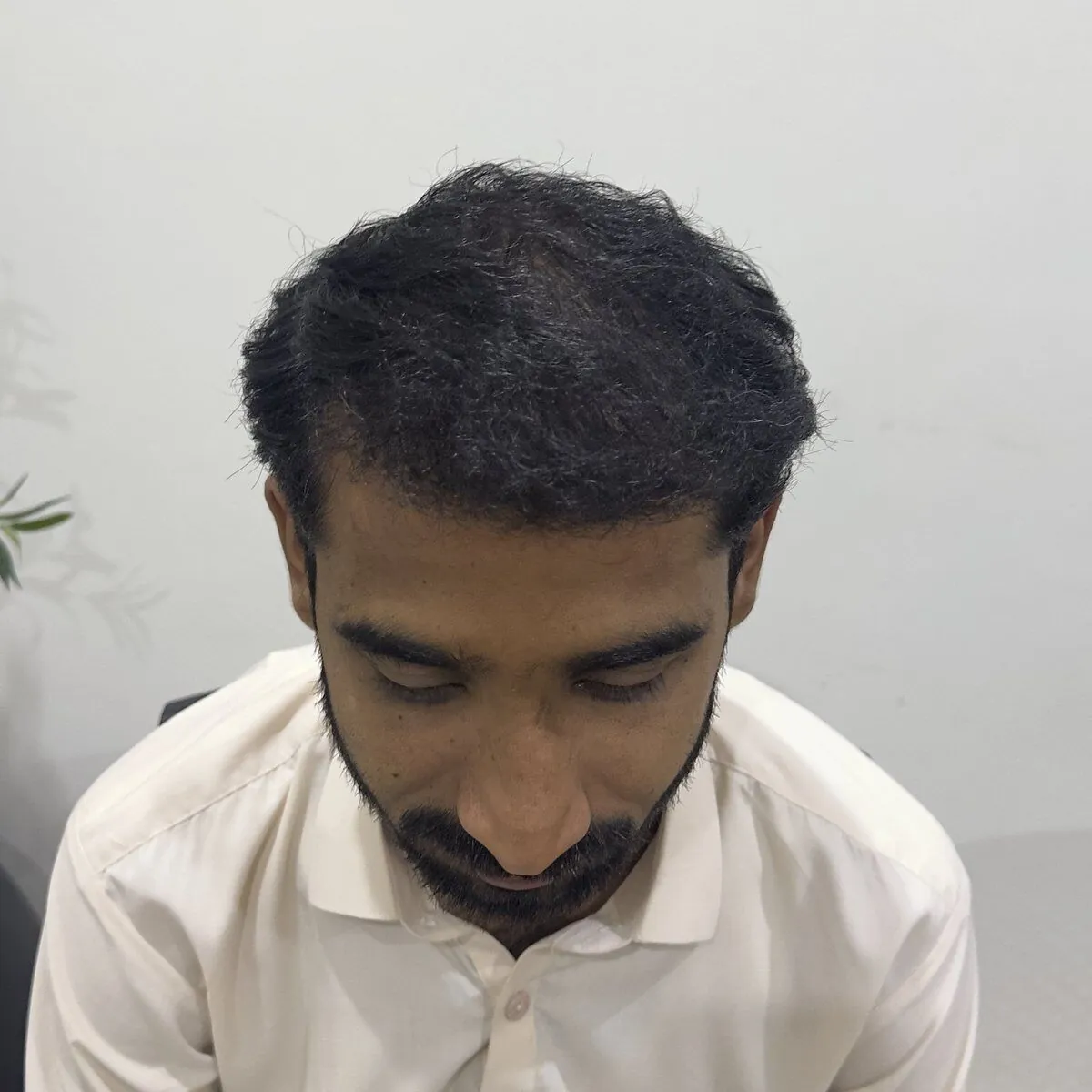
 Before
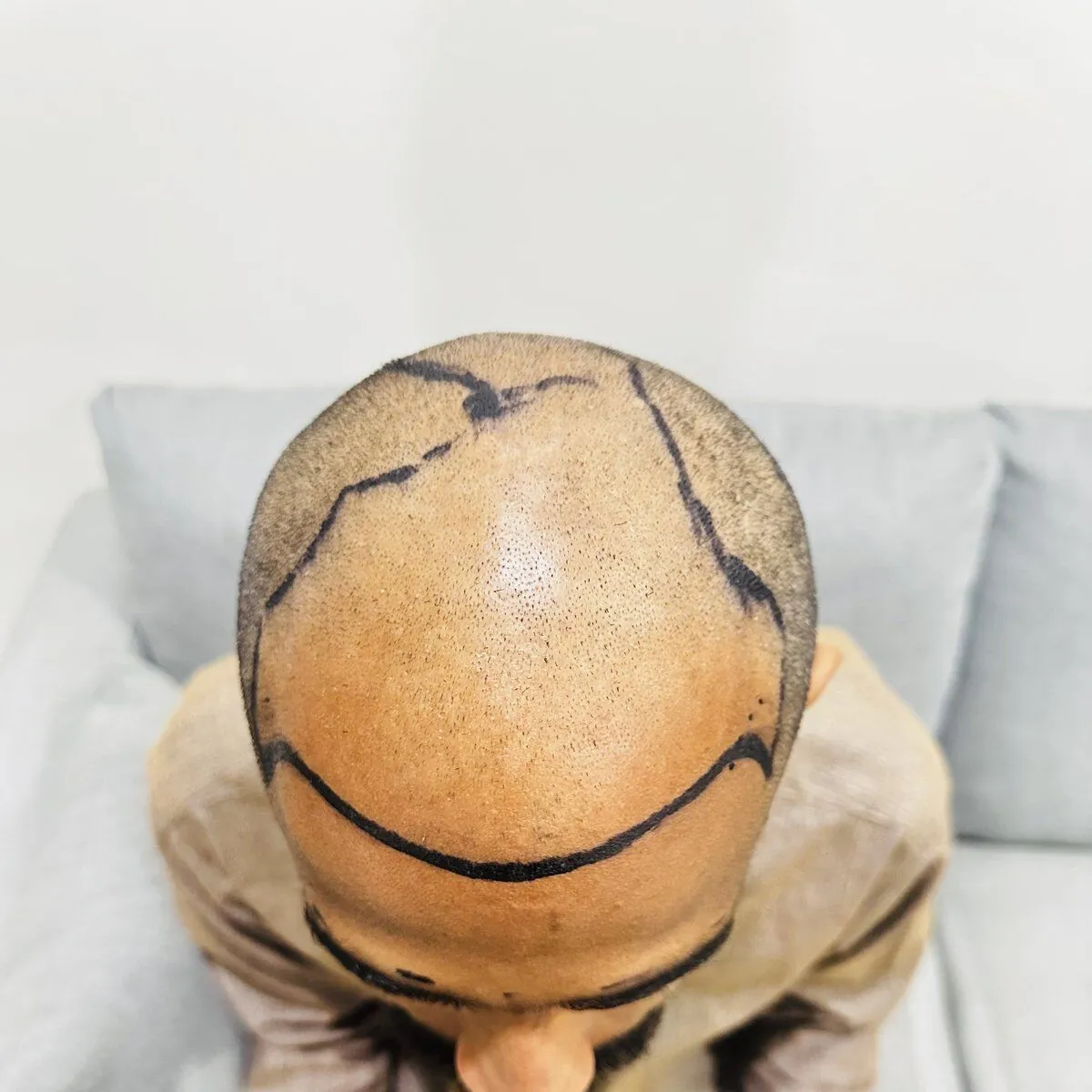
After
Photos are shared with patient consent. Results vary from person to person. See more results
Benefits of FUE Hair Transplant
No Linear Scar
Grafts are taken one by one, so there is no strip scar across the back of your head.
Grows Like Your Own Hair
Hair is moved in its natural groups of one to four, so it blends with the hair around it.
Quicker Return to Routine
Many people are back at a desk job within about a week, once redness and crusts settle.
Long-Lasting Growth
Donor hair is usually resistant to pattern thinning and tends to keep growing after the move.
Planned Around You
Hairline height, shape and density are designed for your age, face and likely future hair loss.
Surgeon-Led Planning
Dr. Junaid designs your plan and hairline himself, and his team follows you through the growth months.
Are you a good candidate?
FUE may suit you if you:
- Have pattern hair loss with healthy, dense hair at the back and sides of the scalp
- Have a pattern that has settled enough to plan around, usually from your mid-twenties onwards
- Like to keep your hair fairly short and would rather avoid a linear scar
- Want to restore a receding hairline, the temples or a thinning crown
- Are in good general health, with any diabetes or blood pressure well controlled
- Understand that density is limited by your donor hair and may need more than one session
Women with thinning hair can also be candidates, but female hair loss is often spread across the scalp, so Dr. Junaid checks for medical causes first and only advises surgery when the donor area is stable.
Recovery & aftercare
The scalp heals within days, but the new hair takes many months to come through. A typical timeline looks like this:
- Days 1–3
Mild swelling of the forehead and tenderness at the back are common. Sleep with your head raised and avoid touching the grafts.
- Days 4–10
Small crusts loosen with the gentle washing routine the team shows you. Many people return to desk work towards the end of this stage.
- Weeks 2–6
Most transplanted hairs shed. This is expected, because the roots stay in place and rest before they regrow.
- Months 3–6
New hairs begin to appear, often fine and wispy at first, and gradually become stronger.
- Months 6–12
Growth thickens and the look becomes more natural. The final result is usually judged at 12–18 months.
Avoid heavy exercise, swimming, direct sun and smoking for as long as the team advises. In the summer heat, staying out of the midday sun and wearing a loose cap once you are allowed one helps protect the healing scalp.
What patients say
Dr. Junaid transformed my confidence with an incredible hair transplant. Professional, discreet, and amazing results. Highly recommended!
After years of hesitation, I finally got my hair transplant done by Dr. Junaid. The density and natural hairline exceeded my expectations.
Came from Rawalpindi for Dr. Junaid's expertise. The FUE procedure was painless and the results started showing within 4 months. Worth every penny.
Flew in from Karachi for my hair transplant. Dr. Junaid's technique is world-class. The grafts took perfectly and the results are life-changing.
Related articles
Hair Restoration
Hair Transplant Cost in Pakistan: What Affects the Price
What decides the cost of a hair transplant in Pakistan: graft count, technique, who does the work, facility and aftercare, plus red flags in...
Hair Restoration
FUE vs FUT Hair Transplant: Which Method Is Right for You?
FUE or FUT? Dr. Junaid Fateh explains how each hair transplant method works, the scars and recovery involved, and who tends to suit which...
 Hair Restoration
Hair Transplant Side Effects and How to Reduce Them
Swelling, scabs, numbness, shock loss and folliculitis after a hair transplant: what is normal, how to reduce side effects and when to...
FUE Hair Transplant FAQs
How much does an FUE hair transplant cost in Lahore?
The fee depends mainly on how many grafts you need, the size of the area, whether more than one session is planned and any extra treatment such as PRP. Dr. Junaid gives you a personalised quote once he has examined your scalp, and the cost guide explains these factors in more detail.
Is FUE painful?
The local anaesthetic stings for a short while at the start, then the scalp goes numb. During the procedure most people feel pressure rather than pain and can rest or watch something. Soreness and tightness for a few days afterwards are usually controlled with the painkillers the team prescribes.
How long do FUE results last?
Transplanted hair comes from an area that is usually resistant to pattern baldness, so it tends to last for the long term. The original hair around it can still thin with age, which is why Dr. Junaid may suggest medication or PRP to help protect it. Results vary between people.
How much time off work will I need?
Many people with desk jobs go back after about a week. If your work is physical, dusty or outdoors in the heat, plan for closer to two weeks. Redness and small crusts usually settle within 7–10 days.
How many grafts does an FUE transplant need?
That depends on the area being treated, the density of your donor hair and the look you want. A hairline on its own needs far fewer grafts than a hairline plus crown. The graft estimator on the hair transplant page gives a rough idea, and Dr. Junaid confirms the number after examining you.
Will the donor area look thin or scarred?
Grafts are spread out across the donor zone so that it does not look patchy. FUE leaves tiny round marks rather than a line. At normal hair lengths these are usually hard to spot, although a shaved head or very short fade may show them.
Can I have an online consultation from abroad?
Yes. Many overseas Pakistanis start by sending clear photos of the front, top, crown and back of the scalp on WhatsApp, then book a video consultation with Dr. Junaid. He can give an initial opinion and a rough plan, and the final graft count and hairline are confirmed in person before surgery.
Can I have it done in time for a wedding?
Plan well ahead. The scalp usually looks presentable after about two weeks, but new hair takes 6–12 months to show properly and longer to mature. If you want the full effect for a family wedding, booking around a year beforehand is sensible.
What are the risks or side effects of FUE hair transplant?
Common, short-lived effects are forehead swelling, redness, small crusts, tenderness and some numbness of the scalp. Less often there may be infection, small pimples around the grafts (folliculitis), temporary shedding of existing hair or uneven growth. Dr. Junaid reduces these risks with a careful assessment, a graft number your donor area can safely give, sterile technique and a clear aftercare plan, and he goes through them with you at consultation.
What is the best age for FUE hair transplant?
There is no single best age, but results are more predictable once your hair loss pattern has settled, usually from the mid-twenties onwards. If you are younger and losing hair quickly, Dr. Junaid often suggests medication or PRP first, because a hairline placed too early may not suit the pattern that develops later. Older patients and women are assessed on donor density and general health rather than age alone.
Roman Urdu mein maloomat (ایف یو ای ہیئر ٹرانسپلانٹ)
FUE hair transplant mein sar ke peeche se baal ek ek kar ke nikale jate hain aur ganjapan wali jagah par lagaye jate hain, is liye lambi line wala nishan nahi parta. Dr. Junaid Fateh, FCPS plastic surgeon, Lahore mein yeh procedure karte hain. Apne sar ki tasveerein bhej kar mashware ke liye WhatsApp par rabta karein.
WhatsApp par mashwara book karein