 By Dr. Muhammad Junaid Fateh
· Updated · 5 min read
Key takeaways
- Most side effects, such as swelling, scabs, soreness, itching and numbness, are mild and settle within days to a few months.
- Transplanted hairs usually shed between about two and six weeks after surgery; the roots stay and regrow.
- Folliculitis can appear as small pimples when new hairs push through and usually settles with simple care.
- Donor over-harvesting and an unnatural hairline are mostly prevented by careful planning before surgery.
- Contact the team for bleeding that will not stop, worsening pain, spreading redness, pus or fever.
Most hair transplant side effects are mild and temporary: swelling of the forehead, small scabs, soreness, itching, numbness and the shedding of transplanted hair in the first few weeks. Less common problems, such as infection, an over-harvested donor area or an unnatural hairline, are largely reduced by careful planning, sound technique and following your aftercare instructions.
In this guide, Dr. Junaid Fateh explains what each side effect looks like, what you can do about it, and which signs mean you should get in touch. Timings are typical ranges, and your own recovery may differ.
Common, short-lived side effects
Swelling
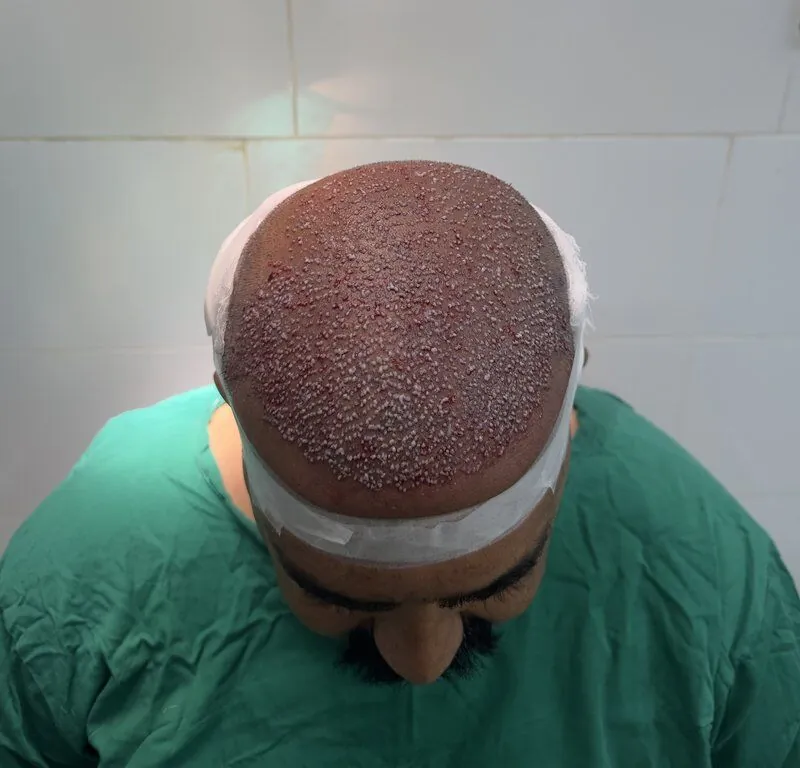
Swelling usually builds over the forehead in the first two to three days and can drift down around the eyes. It looks worrying but is not harmful, and it usually settles within about a week.
To reduce it, sleep with your head raised on two or three pillows, avoid bending forward or lifting heavy things, and use a cold pack on the forehead if the team advises it. Never press anything on the grafts themselves.
Soreness and tightness
Most people describe mild to moderate soreness for a few days, which the prescribed painkillers usually control. After FUT, the line at the back of the head can feel tight for a week or two. Avoid over-the-counter painkillers that can increase bleeding unless the team has approved them, and never stop a prescribed medicine without asking the doctor who prescribed it.
Scabs and crusts
A small crust forms around each graft. With the gentle washing routine the team shows you, the crusts soften and come away, usually by the end of the second week. Picking them early can pull out grafts, so leave them alone.
Numbness and tingling
Fine nerves in the scalp are disturbed during surgery, so patches of numbness or tingling in the donor and recipient areas are common. Feeling usually returns gradually over weeks to a few months. If numbness has not improved by your review, mention it.
Itching and light bleeding
Itching is a sign of healing, but scratching can damage grafts, so ask the team what you can use to ease it. Light spotting in the first day or two is normal and usually stops with firm, gentle pressure using clean gauze.
Shock loss
There are two kinds of shedding after a transplant. First, most transplanted hairs fall out between about two and six weeks after surgery. This is expected: the hair shaft sheds while the root stays alive and prepares to grow a new hair.
Second, some of your existing hair close to the treated area may thin for a while. This is called shock loss. In most people it grows back over the following months. The risk is reduced by placing grafts carefully between existing hairs and, where suitable, by starting medical treatment or PRP hair therapy to strengthen your own hair before surgery.
For a full week-by-week guide, read the hair transplant recovery timeline.
Folliculitis and pimples
Around two to four months after surgery, small pimples can appear where new hairs are pushing through the skin. This is called folliculitis. Most spots settle on their own with gentle washing. Do not squeeze them. Tell the team if they become painful, swollen, numerous or keep spreading, as some people need a short course of treatment.
Infection
Infection after a hair transplant is uncommon. Signs include spreading redness, warmth, pus, a bad smell or fever. The risk is reduced by sterile technique, clean hands, following the washing instructions, and avoiding swimming pools, the sea and very dusty places for about a month.
Donor over-harvesting
The back and sides of the scalp hold a limited supply of hair. If too many grafts are taken, or they are taken unevenly, the donor area can look thin, patchy or “moth-eaten”. Follicles that have been removed do not grow back, so this is difficult to fully correct.
Dr. Junaid prevents this by keeping the graft count within what your donor area can safely give, spreading extraction evenly, and choosing FUT, a combination or staged sessions when a large number of grafts is needed. He also keeps some donor hair in reserve in case you need more work later.
An unnatural hairline
A hairline that is too low, too straight, too dense in one spot or angled the wrong way is what usually gives a transplant away. It can also look out of place years later if the hair behind it keeps thinning.
To avoid this, Dr. Junaid draws the hairline to suit your age and face, gives it a soft, slightly irregular edge with fine single-hair grafts at the front, and follows the natural direction of your hair. He plans for likely future loss rather than only for today.
Other things to know
- Patchy or weaker growth: not every graft survives, and growth varies between people. Smoking, rubbing the grafts and some health conditions can reduce growth.
- FUT scar: in most people it heals as a fine line, but in some it stretches and becomes wider.
- Small cysts: occasionally a graft sits too deep and forms a small bump, which usually settles or can be treated simply.
Normal or worth a call?
| What you notice | Usually normal | Contact the team |
|---|---|---|
| Swelling | Forehead and around the eyes in the first week | Swelling with fever or spreading redness |
| Bleeding | Light spotting in the first day or two | Bleeding that has not stopped after 10–15 minutes of firm, gentle pressure |
| Pain | Mild to moderate, improving each day | Pain that keeps getting worse |
| Scabs | Small crusts that come away by about two weeks | Thick yellow crusts, pus or a bad smell |
| Numbness | Patchy numbness that slowly improves | Numbness not improving after several months |
| Pimples | A few small spots as new hair grows | Many painful, swollen or spreading spots |
| Hair shedding | Transplanted hair falling out in weeks two to six | Sudden patchy hair loss elsewhere on the scalp |
Contact Dr. Junaid’s team on WhatsApp if anything in the right-hand column applies to you. If you feel very unwell, have a high fever or bleeding you cannot control, seek urgent medical care.
How Dr. Junaid reduces the risks
Before surgery, Dr. Junaid asks about your health, medicines and smoking, and may request blood tests if you have diabetes, high blood pressure or unexplained hair fall. He sets a realistic graft count, designs the hairline with you, carries out the procedure under sterile conditions and gives you written aftercare instructions with a WhatsApp contact for the team. Like any surgery, a hair transplant carries risks, and he goes through those that apply to you at consultation.
You can read more about the procedures on the FUE hair transplant and FUT hair transplant pages, or on the main hair transplant in Lahore page.
Talk to Dr. Junaid
Whether you are planning a hair transplant or worried about how one is healing, send clear photos of your scalp on WhatsApp and book a consultation in Lahore. If you live in another city or abroad, a video consultation is available, and the overseas patients page explains how to plan your visit.
This article is general information and not a substitute for a personal medical consultation.
Quick answers
Are hair transplant side effects permanent?
Most are not. Swelling, scabs, soreness and itching usually settle within the first two weeks, and numbness generally improves over weeks to a few months. Lasting problems, such as a thin donor area or an unnatural hairline, are uncommon when the procedure is planned carefully.
How long does swelling last after a hair transplant?
Swelling often builds over the first two to three days, can spread to the area around the eyes, and usually settles within about a week. Sleeping with your head raised and avoiding bending forward help to reduce it.
What is shock loss and will my hair grow back?
Shock loss is temporary shedding of hair after surgery. The transplanted hairs usually fall out in the first few weeks, and some of your existing hair nearby may thin for a while. In most people this hair grows back over the following months.
Can a bad hair transplant be repaired?
Often it can be improved, for example by softening a harsh hairline, adding grafts or removing badly placed ones. What is possible depends on how much donor hair is left. Dr. Junaid assesses this at consultation and gives you an honest view.
About the author
Dr. Muhammad Junaid Fateh
Plastic, Cosmetic & Reconstructive Surgeon (MBBS, FCPS (Plastic Surgery)) seeing patients in Lahore. Read more about Dr. Junaid.