Quick answer
Mole and skin tag removal cuts, shaves or seals away unwanted moles and skin tags, with neat closure to limit scarring and lab testing of any suspicious mole. In Lahore it is performed by FCPS plastic surgeon Dr. Junaid Fateh. It takes 15 to 30 minutes under local anesthetic, with 3 to 7 days of recovery. Results are permanent. Cost depends on your plan and is confirmed after consultation.
Also known as: Mole excision, Skin tag removal, Mole biopsy, Shave removal of moles, Til hatwana, Til ka ilaj, Masse hatwana, Chehre ka til nikalwana · تل اور مسے ہٹوانا
About Mole & Skin Tag Removal
Moles are small clusters of pigment cells and are extremely common. Most are harmless and stay the same for years. Skin tags are soft, small flaps of skin that tend to appear on the neck, underarms, eyelids and other places where skin rubs together. Neither usually needs treatment, but many people choose removal because of appearance, or because a lesion keeps catching on clothes, jewelry or a razor.
Sometimes a mole needs attention for medical reasons. Warning signs are often summarized as ABCDE: Asymmetry, an uneven Border, more than one Color, a Diameter larger than a pencil eraser, and Evolving, meaning a change in size, shape or color. A mole that itches, bleeds or looks different from your other moles also deserves a check rather than being ignored.
Dr. Junaid Fateh, a plastic, cosmetic and reconstructive surgeon in Lahore, removes moles and skin tags with attention to both safety and how the skin looks afterwards.
How Dr. Junaid approaches mole removal
Every lesion is examined before anything is removed. Dr. Junaid looks at its size, color, border and history, and asks whether it has changed recently. This decides the safest method. A mole that looks entirely harmless can often be removed with a simple technique, while a mole with any worrying feature is cut out completely with a small margin of normal skin.
Suspicious moles are always sent to a laboratory for histopathology examination, where the tissue is studied under a microscope. This confirms exactly what the mole was and whether it has been fully removed. Dr. Junaid goes through the report with you and arranges any further treatment if it is needed. Lasering or burning off a mole that might be abnormal is avoided, because it destroys the tissue that needs testing.
On the face and neck, the direction and placement of each incision are planned along natural skin creases so the scar is as discreet as possible. Like any procedure, mole removal carries small risks, such as infection, bleeding, a raised or visible scar, a change in skin color and, occasionally, regrowth. Dr. Junaid will explain these before your procedure.
Techniques and options
- Surgical excision: The whole mole is removed with a narrow margin and the skin is closed with fine stitches. This is the standard method for suspicious moles and allows full laboratory testing.
- Shave removal: A raised mole that is clearly benign is shaved level with the skin. No stitches are needed, although some color can occasionally return.
- Snip removal: Skin tags are numbed and snipped off at the base, often in just a few minutes.
- Cautery: Gentle heat seals small tags and lesions and controls any bleeding.
- Cryotherapy: Freezing can be used for some small skin tags and benign spots.
- Laser removal: For selected small, flat lesions that are clearly benign, laser may be an option Dr. Junaid recommends.
What to expect on the day
Most removals take 15 to 30 minutes. The area is cleaned and numbed, the lesion is removed and a small dressing is applied. You go home straight away with wound-care instructions and, if a sample has gone to the laboratory, a plan for discussing the result.
Before & after

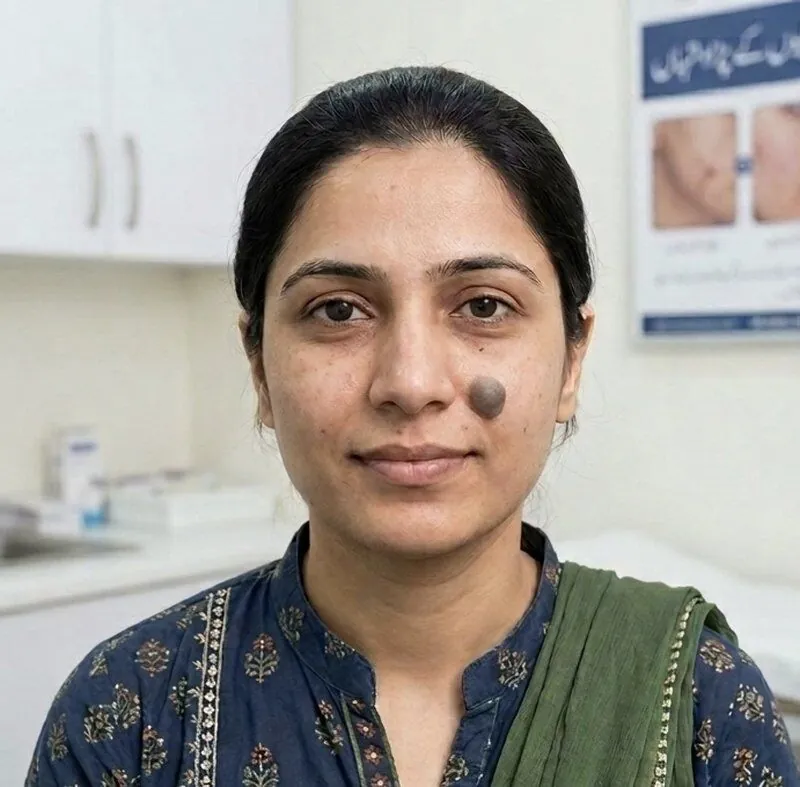 Before
After
Photos are shared with patient consent. Results vary from person to person. See more results
Benefits of Mole & Skin Tag Removal
Clearer Skin
Removing raised or prominent moles and skin tags leaves the skin smoother and tidier.
Lab Testing When Needed
Any mole with worrying features is sent for histopathology, so the tissue can be examined under a microscope.
Short Appointment
Most moles and skin tags are removed in 15 to 30 minutes under local anesthesia.
Careful Scar Placement
Incisions follow natural skin lines, which matters most on the face and neck.
No More Snagging
Tags and raised moles that catch on clothes, jewelry or a razor stop being a daily nuisance.
Right Method for Each Lesion
Excision, shave or cautery is chosen according to what the lesion is and where it sits.
Are you a good candidate?
Mole or skin tag removal may be right for you if you have:
- A mole you dislike the look of, especially on the face
- A mole that has changed in size, shape or color, or that itches or bleeds
- Skin tags on the neck, underarms, eyelids or groin that catch or rub
- A raised mole that gets nicked when shaving or snags on clothing
- A mole you have been advised to have examined or removed
- Several lesions you would like assessed and treated in one visit
If a mole looks suspicious, Dr. Junaid will recommend removing it completely and sending it for laboratory testing rather than taking a cosmetic-only approach.
Recovery & aftercare
Recovery after mole or skin tag removal is usually quick. A typical course looks like this:
- Day 1
A small dressing covers the site. You can return to most normal activities the same day.
- Days 2–7
Keep the area clean and follow the wound-care advice you are given, such as applying ointment and changing the dressing.
- Days 5–14
Stitches, if used, come out after about a week on the face or up to two weeks on the body. Any laboratory result is discussed with you once it is back.
- Months 1–3
The mark starts pink or red and gradually turns paler.
- Months 6–12
The scar matures and softens, and is usually much less noticeable.
Protect the area from the sun while it heals to reduce darkening, and get in touch if you notice spreading redness, discharge or bleeding that does not stop with firm pressure.
Mole & Skin Tag Removal FAQs
Will removing a mole leave a mark?
Any removal that goes through the skin leaves some mark. Dr. Junaid chooses the method and the direction of the incision to keep it as small and discreet as possible. On the face it usually settles into a fine, pale line over several months, though healing varies between people.
Is the mole tested after removal?
If a mole has any suspicious features, it is removed completely and sent to a laboratory for histopathology, where the tissue is examined under a microscope. Dr. Junaid discusses the report with you and explains whether anything further is needed. Where there is any doubt about a mole, he will advise testing it too.
Can a mole grow back?
A mole that has been fully cut out rarely returns. After a shave removal some pigment cells can remain beneath the surface, so a little color may reappear. If a treated mole comes back, Dr. Junaid will want to see it again.
Does mole removal hurt?
A small local anesthetic injection numbs the area and stings for a few seconds. After that you should feel only touch or pressure. Any soreness afterwards is usually mild and eases with simple painkillers.
How long do the results last?
Once a mole or skin tag has been properly removed, the result is permanent. New moles or tags can still appear elsewhere over time, especially skin tags in areas of friction.
Will I need time off work?
Most people go back to work the same day or the next. If the stitches are somewhere that moves a lot, such as the back or near a joint, you may need to avoid heavy lifting or the gym for a week or two.
How much does mole removal cost in Lahore?
The price depends on the number, size and location of the lesions, the removal method and whether laboratory testing is needed. A personalized quote is given at the end of your consultation, and the cost guide has more on how fees are worked out.
Can I have an online consultation from abroad?
Yes. Send clear close-up photos on WhatsApp, ideally with a coin or ruler beside the mole for scale, and book a video consultation. Dr. Junaid can give an initial opinion, but a suspicious mole needs to be examined in person, and the final plan is confirmed at that visit.
What are the risks or side effects of mole removal?
Mole and skin tag removal is a minor procedure, but it still has some risks. Any removal through the skin leaves a mark, and some people form a raised, thickened or darker scar. Other possible problems include infection, minor bleeding and, after a shave removal, a little pigment coming back. Choosing the right method, neat closure, good wound care and sun protection help reduce these risks.
When will I see the final results of mole removal?
The mole or skin tag is gone straight away. The mark left behind starts pink or red, turns paler over one to three months, and usually matures into a much less noticeable scar by six to twelve months. If the mole was sent for testing, Dr. Junaid discusses the result with you once it is back.
Roman Urdu mein maloomat (تل اور مسے ہٹوانا)
Chehre ya jism par mojood til (mole) aur masse (skin tags) ko local anesthesia mein chhote se procedure se hataya jata hai, aur agar til mashkook ho to use lab test ke liye bheja jata hai. Dr. Junaid Fateh Lahore mein mareezon ko dekhte hain. Mashware ke liye WhatsApp par rabta karein.
WhatsApp par mashwara book karein